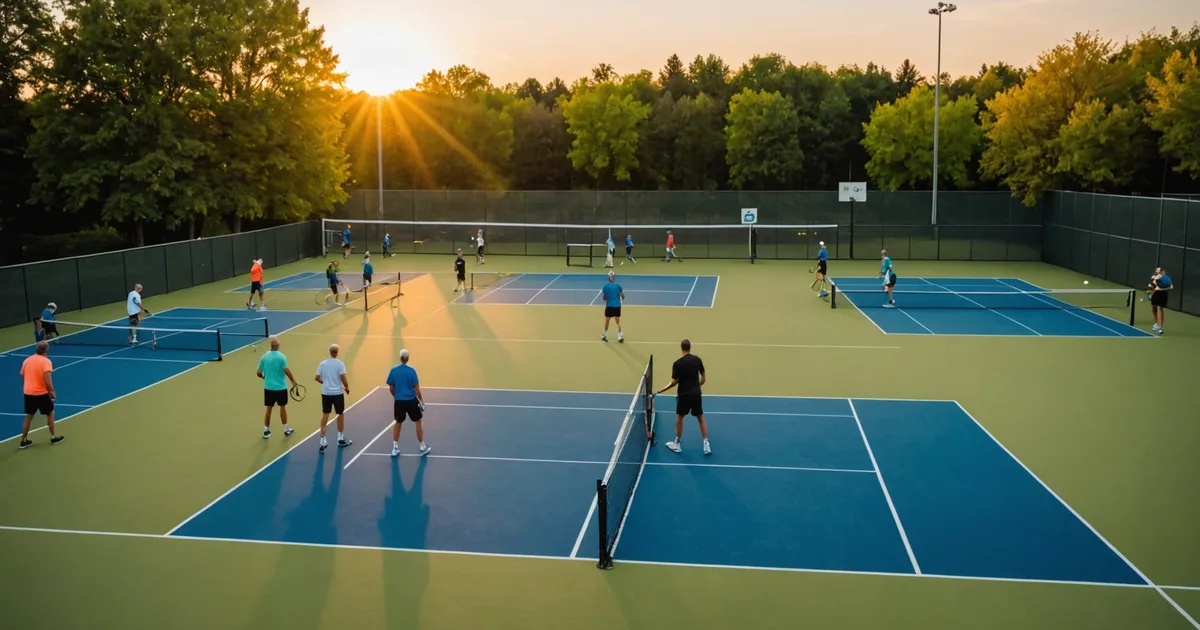
In many pickleball communities, the bottleneck is no longer finding players. It is finding an open court for those players to use. Public parks can have lines waiting for hours, while private clubs fill their court calendars faster than new courts can be added. That imbalance changes the value of every court-hour. When demand is higher than supply, getting people onto a court is only part of the problem. Getting the right people onto the same court becomes just as important.
I see this as both a player and someone building tools for the sport. A crowded facility does not need more names in a group chat. It needs a practical way to organize the players already waiting, understand their levels, and create games that are fair enough to keep moving. Skill-based matchmaking cannot create a new court. It can help a community use the courts it already has with less wasted time and fewer mismatched games.
The court shortage is a scheduling problem and a matching problem
Pickleball's growth has brought together several different player populations. Recreational players, including a large and growing 55-plus segment, want accessible games and a welcoming place to play. Competitive players in their 20s, 30s, and 40s often want stronger opponents, structured sessions, and a clearer path to improvement. Many players move between those groups depending on the day, their partners, and their goals.
That variety is healthy, but it makes unmanaged open play harder. On a quiet day, players can sort themselves out informally. On a busy Saturday, a player may wait through several rotations only to join a game that is far below or above their level. The court is occupied, but the experience is poor for everyone involved. One side is frustrated by the mismatch, the other side may feel pressured, and the next group waits longer.
In a supply-constrained environment, those mismatches carry a real cost. A court that produces a low-quality game is not literally empty, but it is not serving the community as well as it could. The challenge is not to make every game perfectly equal. It is to reduce the avoidable uncertainty that makes crowded play feel inefficient.
What ratings add when courts are scarce
A rating gives players and organizers a shared reference point. It answers a basic question that is often difficult to answer in a new group: who is likely to play at a similar level? That information can shorten the time it takes for players to find a fair pickup game, especially when they do not already know one another.
DUPR is a portable pickleball rating platform built around that problem. A player can carry a rating from one club, park, or organized session to another. The rating is not a guarantee of a particular result, and it should not become a label that prevents people from playing outside their usual group. Its practical use is narrower and more useful: it gives players a common language for organizing play.
For a player arriving at a crowded facility, that can mean finding a compatible game faster instead of asking every person in line about their level. For a club, it can mean setting up skill-tiered open play sessions rather than placing every player into one undifferentiated pool. When courts are limited, a better first match can reduce reshuffling, disputes, and long waits between games.
Our early pilot work includes more than 800 players rated, over 2,400 matches logged, and more than 12 club partners. Those numbers are still a pilot, not a claim that a rating solves the broader capacity problem. They do show the kind of operating information a club can begin to collect when player levels and match results are recorded consistently.
A four-court club has little room for wasted rotations
Consider a typical four-court club in a growing metro area. On a busy evening, 32 or more players may be trying to participate across a limited number of courts, with new players arriving as others finish. The club has several ways to organize the session. It can use a first-come, first-served paddle queue. It can ask players to self-sort. It can reserve courts for different levels. Or it can combine those approaches.
Each method has weaknesses when the club does not know the player pool. Self-sorting tends to favor people who already know one another. A general queue keeps courts active but may create repeated mismatches. Separate level-based courts can work well, but only if the club has a credible way to place players. Staff can make those decisions by observation, though that becomes difficult when the room is full and player levels change over time.
With ratings available, the club can publish a more specific schedule. One block might be intended for developing recreational players, another for intermediate open play, and another for stronger competitive games. The exact bands depend on the club and its community. The important point is that the schedule gives players a reasonable expectation before they arrive, while the rating gives organizers a starting point for placement.
That can improve more than the games themselves. Staff spend less time mediating disagreements about level. Players spend less time searching for partners. A new participant can enter a session with a clearer idea of what to expect. In a facility that cannot add a fifth court this month, those small improvements matter.
This is not an argument against building courts
There is an important boundary here. This article is not an argument that rating systems can replace court construction, better park planning, or expanded access. They cannot. If a city has too few courts for its player population, better matchmaking will not remove the line at the gate. If a private club has more demand than its operating hours can support, data will not create additional evening capacity.
More courts remain necessary in many communities. Municipalities and private clubs are already converting tennis courts and multi-use spaces to respond to demand. Those decisions require careful planning because pickleball players are not the only people using public recreation space. A rating platform has no authority over those choices and should not be presented as a substitute for them.
The narrower argument is that construction takes time, while the shortage exists today. During that period, communities need ways to manage scarce hours more fairly. Rating data can help with that operational layer. It can make a current court schedule more useful, even as cities, clubs, and developers work on longer-term capacity.
What ratings do not solve
Ratings do not solve affordability. A player may have a clear level and still be unable to pay for a private club membership, court reservation, or tournament entry. Ratings also do not solve transportation, inconvenient hours, poor lighting, inaccessible facilities, or a lack of beginner instruction.
They do not guarantee good conduct, either. A player can have an accurate rating and still be unreliable, unwelcoming, or difficult to share a court with. Community norms, staff judgment, and clear rules remain essential. A number should support a better decision, not replace human judgment.
There is also a risk in treating ratings as fixed identities. Players improve. Injuries affect performance. Doubles partners change the shape of a match, and a player's result can reflect the partnership as much as the individual. Any rating system needs enough match context to be useful and enough humility to acknowledge uncertainty.
Finally, not every session needs formal sorting. Some of the best parts of pickleball come from meeting players outside a normal skill group. A club that divides every court too rigidly can lose some of the social mixing that brings people back. The goal is not to turn every recreational session into a competition. It is to give organizers another option when congestion and mismatches are making open play less enjoyable.
The next unit of growth is a better court-hour
The sport's next phase will be shaped by both physical capacity and operating discipline. Communities will continue to need courts, and clubs will need ways to serve players across generations and skill levels without making every session feel chaotic.
For players, that may mean showing up with a portable rating and finding a fair game more quickly. For clubs, it may mean using match history to plan open play, identify underserved levels, and understand which sessions are consistently overloaded. For community platforms, it means treating player identity, availability, level, and local relationships as connected pieces of the same problem.
At DUPR, we are focused on that practical layer. The question is not whether a rating can make a court appear. It cannot. The question is whether, when a court is finally available, the community can use that hour well. In a sport where demand is arriving faster than new capacity, that is a modest goal, but it is a meaningful one.